About
Each year, InCHIP offers workshops for UConn faculty, staff, and students about a variety of topics, such as grant writing, community engaged approaches, and innovative research methodologies. Workshops, generally held twice a semester, vary in topic from year to year and are often available to view on InCHIP’s YouTube page.
Check out InCHIP’s YouTube page to watch past InCHIP workshops, events, and lectures.
Have an idea for a workshop?
Completed Workshops
Spring 2026
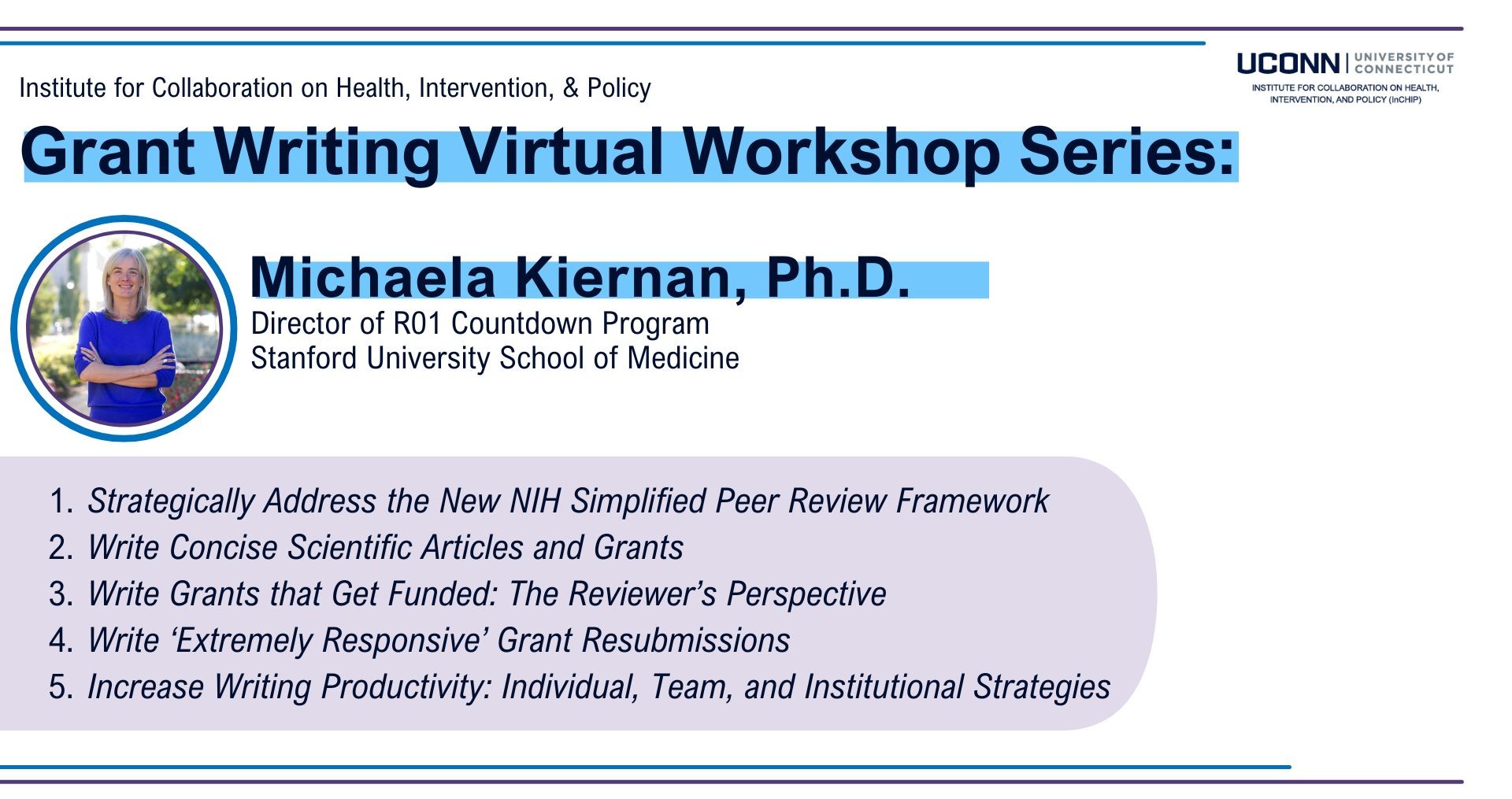
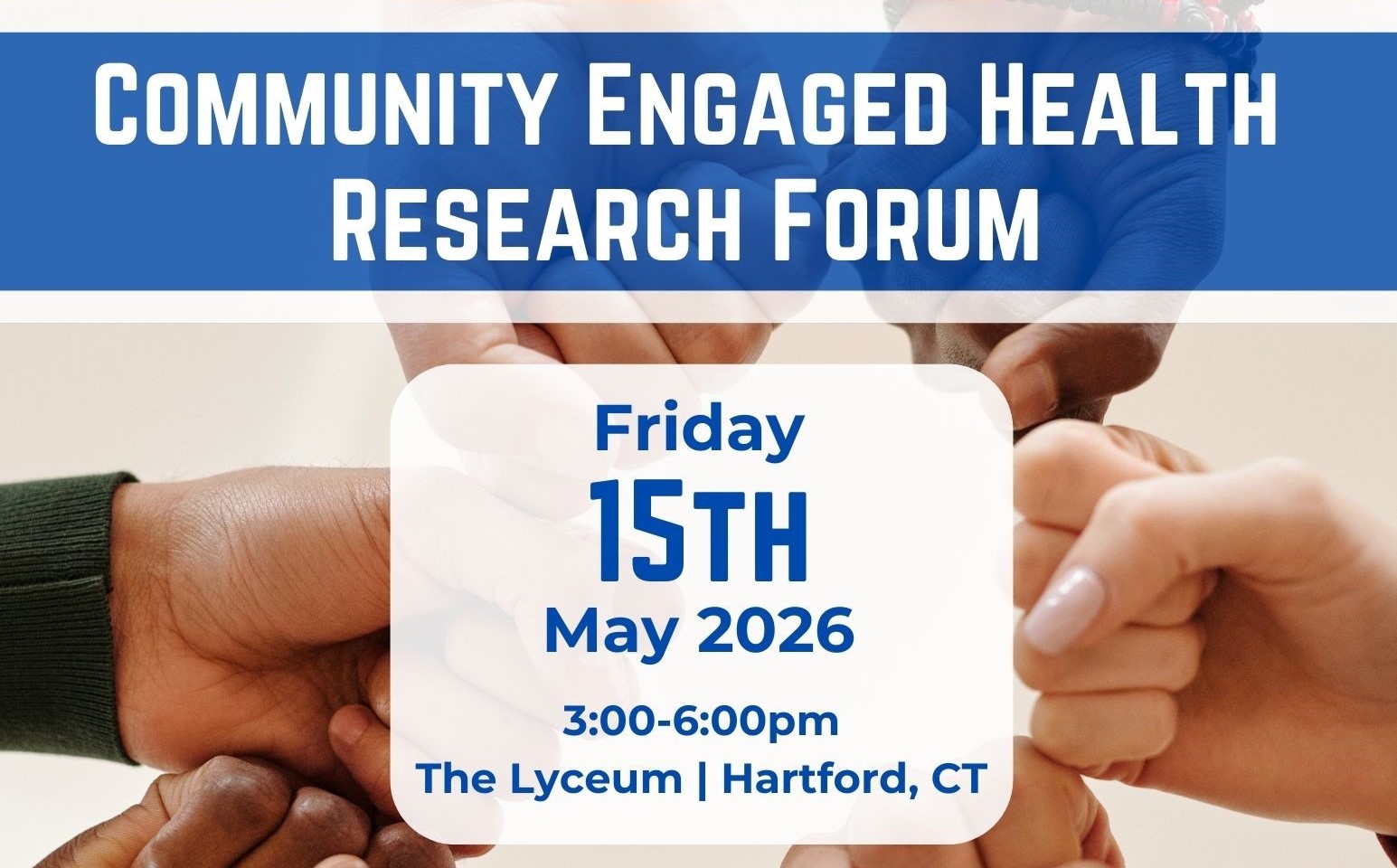
InCHIP hosted an in‑person networking event bringing together UConn faculty and community partners to explore potential collaborations on local initiatives. Participants also had the opportunity to pitch project ideas for consideration for up to $10,000 in pilot funding. The event was co-sponsored by UConn’s Health Disparities Institute.
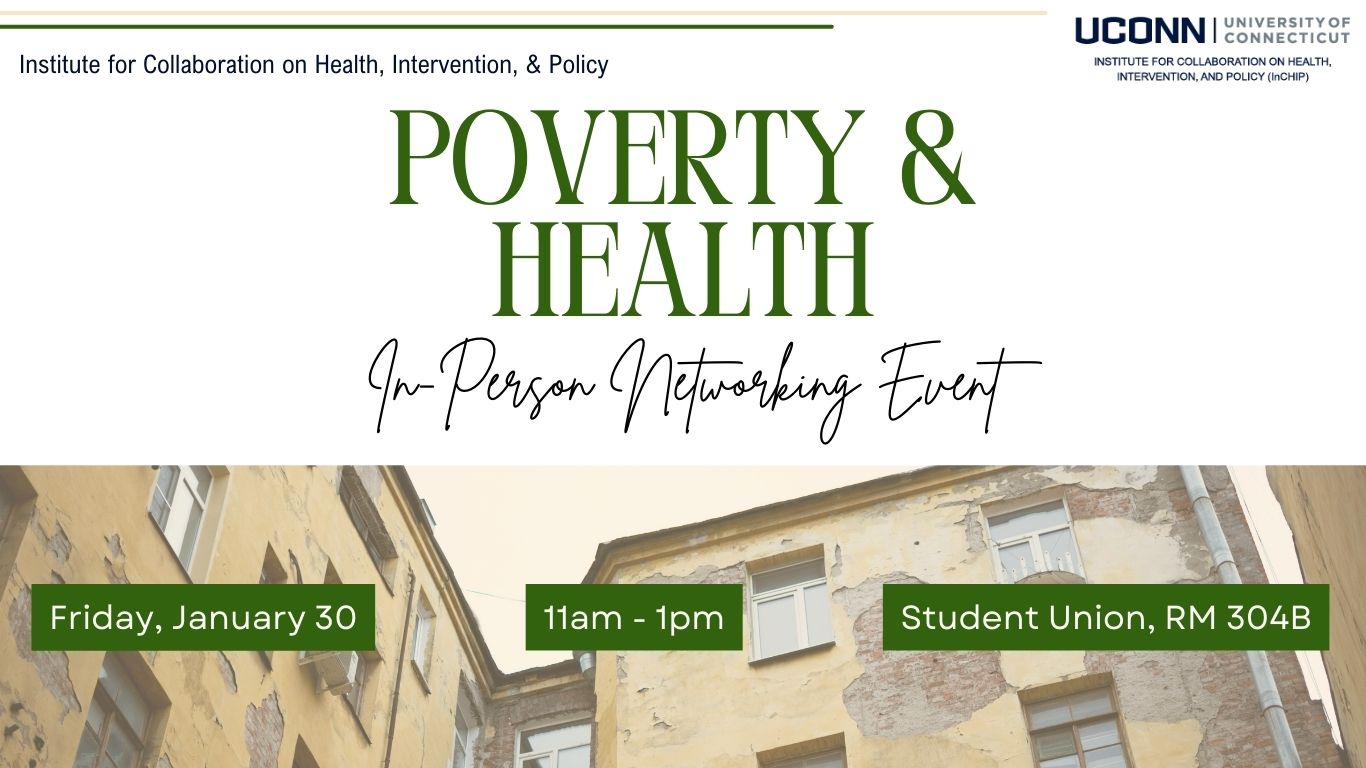
InCHIP convened UConn faculty for an in‑person networking event designed to spark collaboration and inspire new approaches to poverty and health. Participants also had the opportunity to pitch their ideas for two pilot funding awards of up to $30,000.
Fall 2025

Panelists discussed strategies for identifying appropriate foundations to support their work, building strong funding relationships, key differences between writing grants for foundations versus federal opportunities, and important considerations during both the pre‑award and post‑award phases.
Speakers included:
Kerri Raissian, senior research scientist at the Yale School of Public Health
Marlene Schwartz, professor in the Department of Human Development and Family Sciences, and director of the UConn Rudd Center for Food Policy and Health
Molly Waring, associate professor of Allied Health Sciences
Frances Fleming-Milici, Director of Food Marketing Initiatives at the UConn Rudd Center
Greidy Miralles, Research Development Coordinator at InCHIP
Tricia Leahey, professor of Allied Health Sciences and InCHIP Director, moderated the event.
This event was not recorded.

Social media can be a powerful tool for sharing information, connecting with like-minded individuals, and learning about new topics. For researchers, social media can be used to disseminate findings, reach new audiences, and recruit study participants. However, it can be difficult to gain traction online, build an audience, or navigate negative attention.
Recognizing these challenges, InCHIP hosted a virtual workshop to help UConn researchers and labs enhance their social media presence. Participants learned ways to grow their audience and tap into new networks, use platform features to expand post reach and engagement, curate content, and establish credibility.
Panelists included:
Sherry Pagoto, Director, UConn Center for mHealth and Social Media & Professor, Department of Allied Health Sciences
Molly Waring, Associate Professor, Department of Allied Health Sciences
Marlene Schwartz, Director, UConn Rudd Center for Food Policy and Health & Professor, Department of Human Development and Family Sciences
Carson Hardee, Director of Communications, UConn Rudd Center for Food Policy and Health
Emily Zangari, Director of Digital Content and Strategy, University Communications
Spring 2025

The InCHIP NIH Grant Writing Boot Camp provided UConn faculty and students interested in writing an NIH grant (R-, K-, or F-series) with an introduction to the NIH grant writing process through a one-day, in-person workshop followed by an optional intensive mentored training program. The in-person workshop provided an introduction to the NIH and core strategies for building a successful NIH grant application.
The workshop was delivered by highly accomplished NIH-funded PIs that included:
Tricia Leahey, PhD, InCHIP Director, Professor of Allied Health Sciences
Caitlin Caspi, ScD, InCHIP Associate Director, Associate Professor of Allied Health Sciences
Seth Kalichman, PhD, Professor of Psychological Sciences
Michael Copenhaver, PhD, Professor of Allied Health Sciences
Lisa Eaton, PhD, Professor of Human Development & Family Sciences
Sherry Pagoto, PhD, Professor of Allied Health Sciences.
AnnMarie White, InCHIP Grants Manager
Alex Doming, InCHIP Grants & Contracts Specialist
A post-workshop optional mentored training program provided participants with ongoing structure, accountability, and iterative feedback on their proposals throughout the grant writing process.
This event was not recorded.
Fall 2024
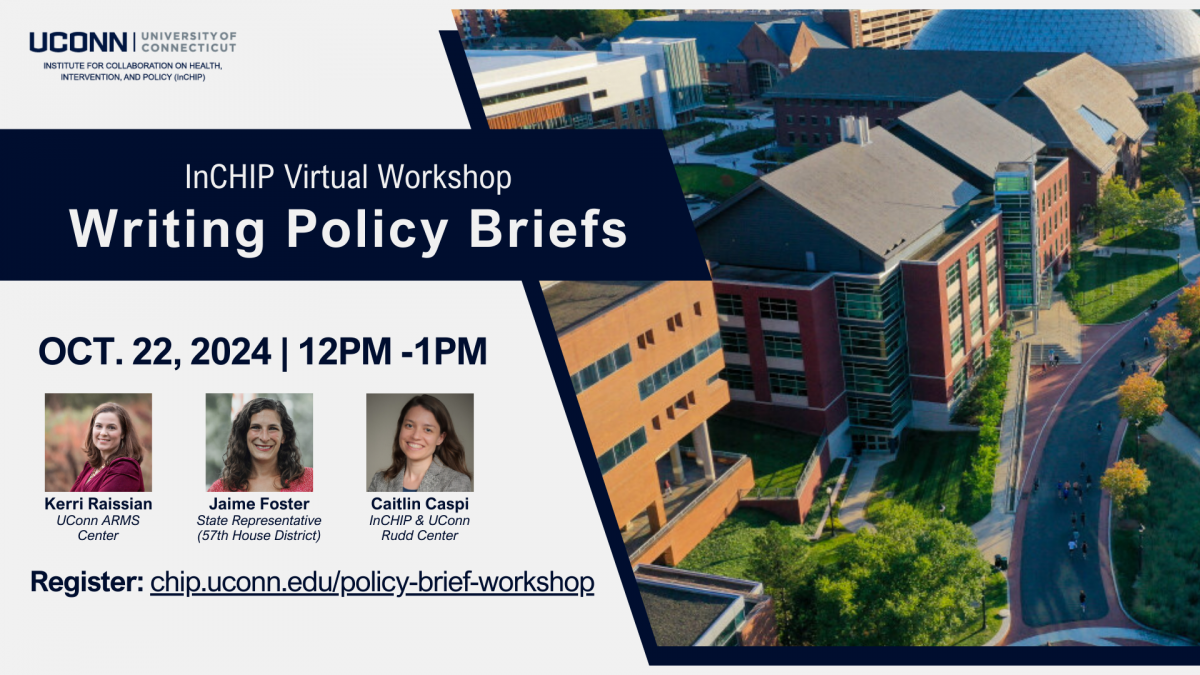
Featuring: Kerri Raissian (UConn Center for Advancing Research, Methods, and Scholarship in Gun Injury Prevention & School of Public Policy); State Representative Jaime Foster (57th Assembly District); Caitlin Caspi (UConn Rudd Center for Food Policy and Health & Allied Health Sciences Department)
About: During this virtual workshop, participants will learn best practices for writing policy briefs and disseminating their research to policymakers. Participants will also gain a network of resources that can provide feedback on their policy briefs.
Spring 2024
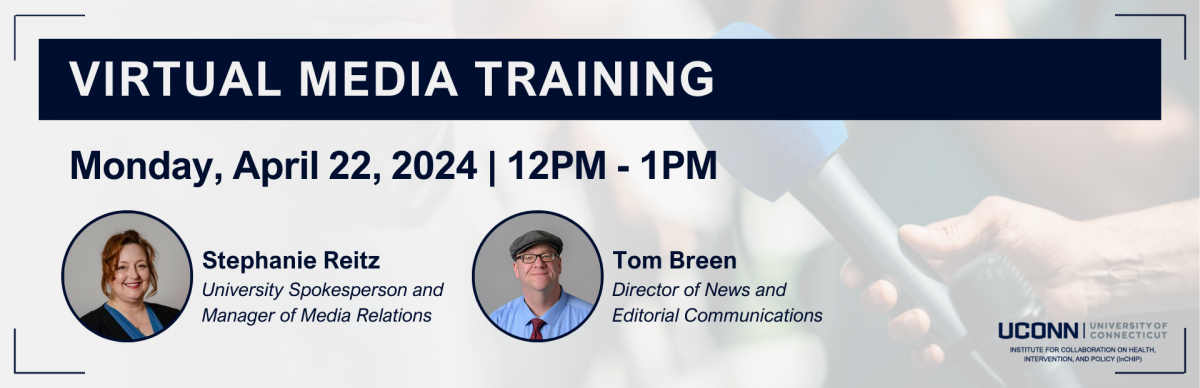
Featuring: Stephanie Reitz, University Spokesperson and Manager of Media Relations, and Tom Breen, Director of News and Editorial Communications
About: This event provided faculty researchers with training on how to effectively engage with members of the news media. Participants learned about the importance of deadlines, when to defer to University Communications, tips on speaking with nontechnical audiences, and more.
Fall 2023
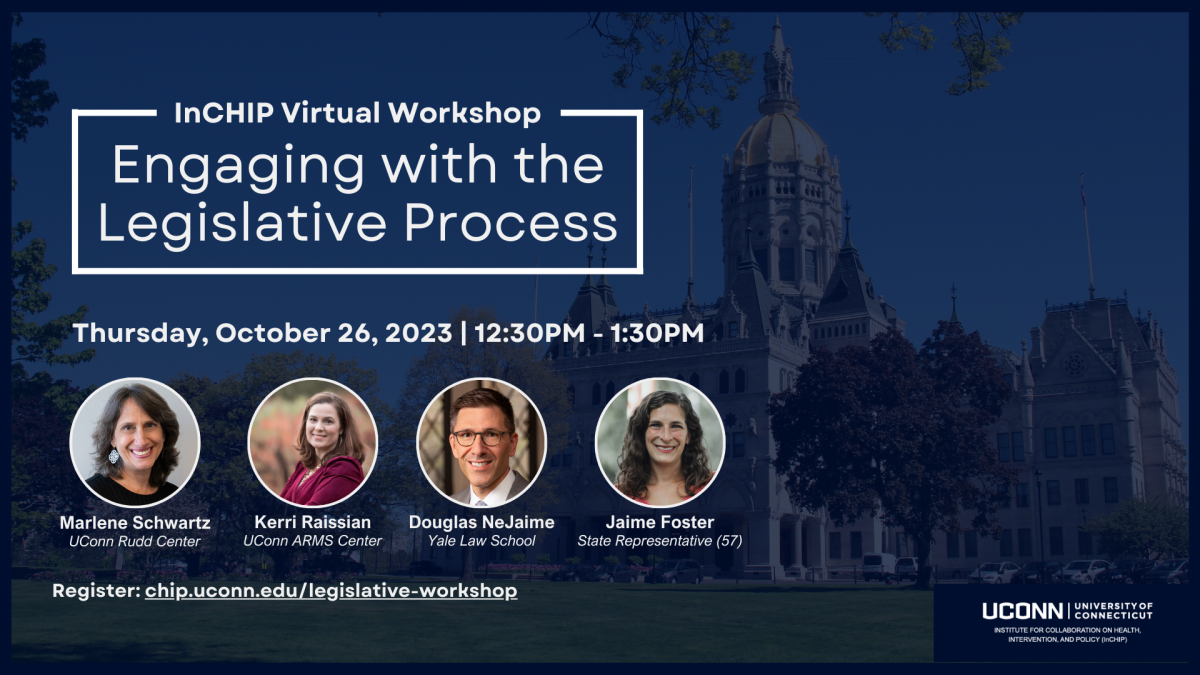
Featuring: Marlene Schwartz (UConn Rudd Center for Food Policy and Health & Human Development and Family Sciences); Kerri Raissian (UConn Center for Advancing Research, Methods, and Scholarship in Gun Injury Prevention & School of Public Policy); State Representative Jaime Foster (57th Assembly District)
About: InCHIP held a first-ever legislative engagement webinar, which showed how InCHIP principal investigators and other research professionals can engage in the legislative process to translate research findings into public policy solutions.
Spring 2023
InCHIP Undergraduate Research Academy
Featuring: Tricia Leahey, PhD (InCHIP & Allied Health Sciences); Grace Morris, MA (InCHIP); Na Zhang, PhD (HDFS); Ryan Talbert, PhD (Sociology); Nathaniel Rickles, PharmD, PhD (Pharmacy Practice)
About: Are you an undergraduate student interested in becoming a research assistant? In this discussion, the panelists provide their insight and answer questions about how to become a research assistant and what such position entails.
Spring 2022
NIH Biosketch Workshop: How to Effectively Communicate Your Scientific Expertise and Research Experience
Featuring: Kim Gans, PhD (Human Development and Family Sciences) & Amy Gorin, PhD (InCHIP and Psychological Sciences)
About: Are you applying for your first NIH Grant? Or has it been a few years since you submitted a proposal to NIH? This workshop will address changes to the NIH Biosketch format implemented in 2021. The new format impacts how applicants describe their ongoing and completed research and their scientific appointments. This workshop will also address best practices for crafting a Biosketch over the course of one’s career.
Professor Human Development and Family Sciences
Director, InCHIP &
Professor, Psychological Sciences
Better Living through Chemistry: How the Complexities of the Molecular World are Connected with Our Health and Well-Being
Featuring: Alexander Aksenov, PhD (Chemistry)
Personalized medicine or disease diagnostics kits that one can order in the mail used to be something from sci-fi, but now are becoming commonplace, fueled by scientific breakthroughs. Mass spectrometry (MS) is a key analysis technique that allows deciphering complex molecular distributions (so-called MS-based metabolomics). However, the high cost and difficulty in large scale data analysis have been hampering MS applications.
In the past few years, the MS-based metabolomics has been undergoing a revolutionary transition. Many new tools, especially in data analysis, have emerged and now enable endeavors that were not possible due to previously unsurmountable technical limitations.Disease detection, monitoring of chemistry of our surroundings (e.g. toxins), or designing nutrition for health effects, etc., all are now possible and will eventually become routine. Adopting new technologies, however, is notoriously challenging as it requires navigating entirely different set of aspects outside of just technical consideration.
To harness the potential power of mass Spectrometry, new interdisciplinary collaborations are needed to explore how best to introduce this technology into our everyday lives. This is where the analytical chemistry meets the social and behavioral sciences. Sociology, political sciences, psychology, and many of other social and behavioral science domains are essential for maximizing benefits of these new technologies while minimizing possible harm. In this talk, Dr. Alexander Aksenov (Chemistry) will provide a high level overview of his work on metabolomics and invite conversation about what might be possible moving forward with interdisciplinary collaboration.