Quick Facts:
The UConn Elisabeth DeLuca School of Nursing's Biobehavioral Research Laboratory is offering supplemental funding to InCHIP seed grant applications that include biobehavioral components.
- Awards up to $5,000 in Biobehavioral Research Lab credit are available.
- Projects that involve biological sample collection and assessment of biomarker(s) that can be processed and analyzed in the Biobehavioral Research Lab are eligible.
Purpose:
The UConn Elisabeth DeLuca School of Nursing’s Biobehavioral Research Laboratory (BBL) is offering supplements to InCHIP seed grant applications that aim to include biobehavioral components. Projects that involve biological sample collection and assessment of biomarker(s) that can be processed and analyzed in the BBL are eligible for this supplement. Awards up to $5,000 in BBL credit are available.
More information about the BBL facilities and services can be found at https://bbl.nursing.uconn.edu/.
Description:
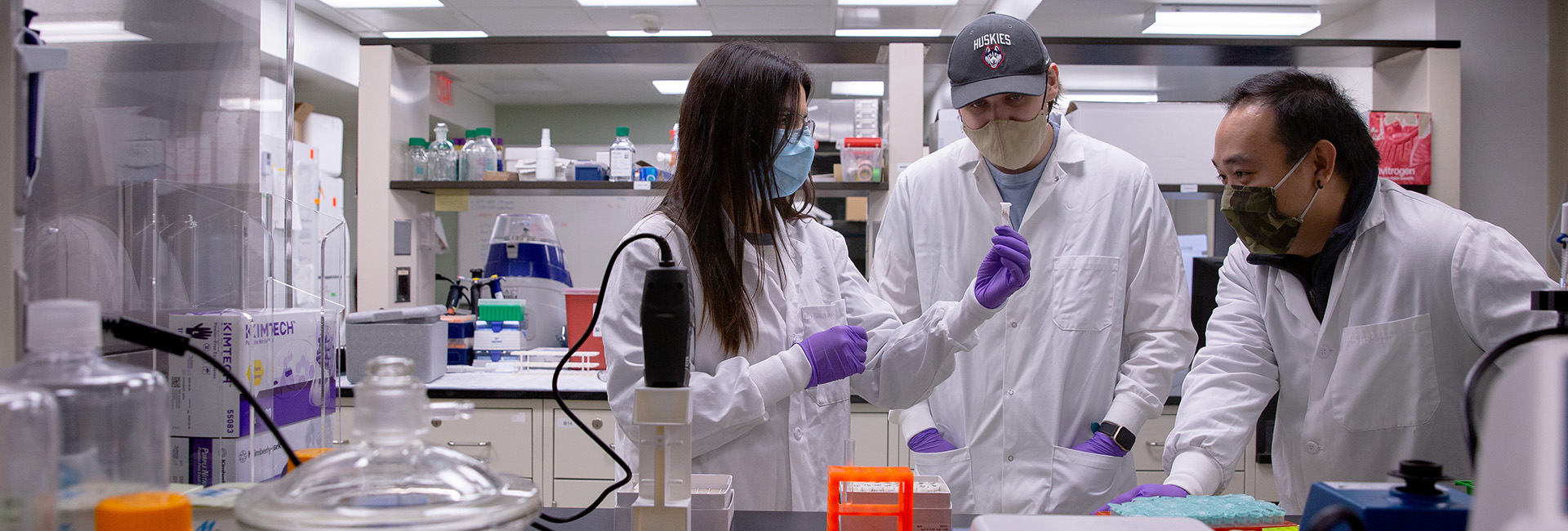
The BBL is a UConn research lab with facilities on the Storrs and Waterbury campuses dedicated to supporting faculty and student research, particularly at the intersection of behavior and biology. The BBL operates a wet lab in Beach Hall on the Storrs campus and behavioral labs in the Arjona Building on the Storrs campus and Neil O’Leary Building on the Waterbury campus.
The behavioral lab are equipped with several spacious and private rooms for human subjects data collection, including interviews, surveys, physical assessment (e.g., height and weight, blood pressure, exam table), pain assessment, intervention administration, and sample collection (e.g., blood, saliva). For convenience, participant parking is available right next to the building free of charge. BBL staff are available to train project personnel in collecting simple biospecimens (e.g., hair collection, dried blood spots), or they may be requested to aid in the collection of more complex biospecimens, such as blood draws.
The wet lab is outfitted to receive, process, analyze, and store human and animal samples, including saliva, blood, urine, fecal, hair, and nails. The BBL provides blood components separation (e.g. plasma, serum, PBMC, buffy coat), DNA and RNA extraction and quantification, SNP genotyping, PCR and gel electrophoresis, and enzyme-linked immunosorbent assay (ELISA) services. The lab is equipped with multiple freezers (three -80°C and two -20°C), fridges, and liquid nitrogen tank for short-term and long-term sample storage. BBL’s full-time staff offer free consultations and quotes, process and analyze samples, and assist with data interpretation to help investigators maximize the impact of the impact of their research.
Researchers are encouraged to contact BBL staff (sonbbl@uconn.edu) for a free consultation before applying for the supplement.
Potential Biobehavioral Research Topics Include
- Preparation and processing of most sample types for end-point analyses (e.g., DNA/RNA purification, blood components separation, cortisol extraction).
- Collection of hair and fingernail samples to assess chronic cortisol levels.
- Collection of saliva or blood samples to assess transient cortisol levels.
- Collection of saliva or blood samples to assess cytokines and hormones via ELISA, for example:
- Inflammatory markers, such as interleukins and tumor necrosis factor cytokines.
- Hormones, such as testosterone, estradiol, salivary alpha-amylase.
- Biomarkers of aging, such as telomere length and gene expression.
- Collection of blood spots to assess c-reactive protein (CRP).
- Collection of saliva or blood samples for use in gene expression or SNP genotyping analysis.
- Collection of urine samples for use in cannabinoid metabolite analysis via ELISA.
- Use of quantitative sensory testing equipment for pain sensitivity assessment.
- Use of behavioral lab for physical exam or behavioral data collection.
Researchers are encouraged to contact BBL staff (sonbbl@uconn.edu) for a free consultation before applying for the supplement.
Review Process
This funding opportunity is a supplement to InCHIP seed grant applications. As such, seed grant applications will be reviewed independently to determine eligibility for the BBL supplement. Investigators may receive an InCHIP seed grant, but not the BBL supplement. However, only awarded InCHIP seed grants are eligible to receive a BBL supplement.
Investigators should submit an application to an InCHIP seed grant funding opportunity per the application guidelines. Reviewers for the BBL supplement will receive the parent InCHIP seed grant application provided by InCHIP. Supplement eligibility will be evaluated on the following criteria:
- Significance/Intellectual Merit
- Conceptual/theoretical framework/logic model and empirical evidence that provides the foundation for the incorporation of biobehavioral measures (e.g., biospecimen sample collection and biomarker analysis) to the InCHIP parent proposal work.
- Feasibility
- Project activities regarding biological sample collection procedures and measures, sample storage needs, and proposed analyses.
- Potential for External
- Budget and Justification
- Itemized budget and budget justification that includes supplies, BBL services, and fees. Researchers are encouraged to contact BBL staff (sonbbl@uconn.edu) for a free consultation and budget quote before applying for the supplement.
Budget Requirements
Supplements with budgets up to $5,000 are invited. Funds will be disbursed as a credit to be used in the BBL and will be administered by BBL staff. That is, BBL staff will purchase all supplies necessary for biospecimen collection, processing, storage, and analysis. Additionally, BBL staff will be available to receive, process, store, and analyze samples, as well as consult with investigators at no cost. The BBL will provide two years of sample storage for free.
Allowable Costs - Please consult with BBL on necessary supplies for your project (sonbbl@uconn.edu)
- Expenses related to BBL services (e.g., blood component separation, ELISA)
- BBL equipment use fees
- Supplies necessary for biological sample collection (e.g. blood draw kits, saliva collection devices, fecal collection devices)
- Supplies necessary for biological sample analysis (e.g. ELISA kits, SNP assays, primers, buffers and reagents)
- Consumables for sample storage (tubes, freezer storage boxes, etc.)
- Other specifically authorized expenses essential for carrying out the project
BBL Supplement funds may NOT be used for the following:
- Personnel expenses
- Graduate research assistants and student labor.
- Consultants and other off-campus assistance
- Salary of any Principal Investigator, Co-Investigator, or other faculty member who has an appointment at UConn Storrs, UConn Health, or any of the UConn campuses. This includes Connecticut Children’s faculty with joint appointments.
- Resources outside of the BBL that require fee-for-services within UConn.
- Participant incentives for recruitment or study participation.
- Travel that is necessary to conduct the research or to professional meetings to present the results of the research, or any conference attendance.
- Equipment necessary for conducting the research (“equipment” is defined as an article of tangible, non-expendable personal property that costs $5,000 or more).
- Living expenses.
- Laptops or desktop computers, unless used exclusively for the project and not for any other activities.
- Service/maintenance contracts on equipment.
- Laboratory renovations or other infrastructure renovations.
- Institutional and/or individual memberships in professional organizations.
- Indirect costs, including clerical and administrative personnel salaries.
- Costs associated with the publication of results of the research, such as the purchase of reprints.
- Investigator training costs, including tuition.